Introducing KIT 2.0 Architecture - A New Era of Dataspace Innovation

· 17 min read
Mathias Brunkow Moser
Eclipse Tractus-X Project Lead

KIT 2.0 Architecture

Hello Tractus-X community,

We are excited to announce the launch of KIT 2.0 Architecture - a major redesign of how we visualize and organize our KIT ecosystem. This update brings a fresh perspective to understanding the layered architecture of Eclipse Tractus-X, making it easier than ever to explore and navigate our comprehensive collection of KITs.

What is a KIT?

KIT Framework OverviewKIT Framework Overview

KIT, short for Keep It Together, is an open-source toolbox with comprehensive documentation that enables multiple stakeholders (Business, Solution Providers, Developers) to build interoperable applications compatible with the Eclipse Tractus-X dataspace technologies, and support the compliance with industrial standards from standarization organizations (Catena-X e.V., IDTA, ISO/DIN, EDWG, Manufacturing-X, etc.) and in some cases enable regulatory compliance.

A KIT provides everything needed to implement and deploy specific business scenarios within a dataspace environment - from architectural guidance and API specifications to reference implementations and operational procedures. Each KIT serves as a complete, self-contained package that enables developers, operators, and business stakeholders to understand, build, and run solutions that are interoperable across the dataspace network.

What's New in KIT 2.0 Architecture?

The KIT framework has evolved significantly from version 1.0 to 2.0 to support the growing needs of multiple dataspaces and industries. This transition represents a fundamental shift in how we approach dataspace interoperability - moving from a single-industry focus to enabling multiple industries to leverage the same foundational technologies while maintaining the flexibility to address industry-specific requirements through modular extensions.

KIT 1.0

Legacy

Single-industry focused approach designed specifically for the Catena-X automotive dataspace.

Catena-X automotive only
Single dataspace support
Restricted structure
No clear maturity levels
Evolution

KIT 2.0

Current

Multi-dataspace, multi-industry approach supporting diverse ecosystems including Manufacturing-X and beyond.

Multi-industry support
Cross-dataspace compatible
Modular architecture
Industry-specific extensions
Harmonized Documentation

Multi-Industry Architecture

The new architecture features a beautiful hexagonal layout that visually represents the four main layers of our KIT ecosystem, allowing now KITs to be industry specific:

tip

Click in the architecture components to see a personalized views! Or continue scrolling if you want to know more!

Our KITs Architecture

Building the foundation for interoperable solutions across industries

Click on the building blocks below to explore KITs by category
Automotive
Shop Floor
Semiconductor
Construction
Chemical
+
Other Industries
*All industry logos and trademarks are property of their respective organizations.
Support Us!

Support us on finding a final clasification for each KIT! An initial destribution was done based on the context and requirements from each KIT. In case there is a bug or mistake, feel free to open an issue and inform it at our official office hours. Currently the content of the KITs (the structure) is still not refactored, but it is planned already eclipse-tractusx/sig-release#1567, support and contributions are always welcomed!

Modular Reusable Architecture

Here is a detailed explanation of the diagram above, and how this architecture improves reusability:

USE CASES
CROSS-INDUSTRY USE CASES
INDUSTRY-SPECIFIC USE CASES
CONSTRUCTION
CHEMISTRY
SEMICONDUCTOR
SHOP FLOOR
AUTOMOTIVE
...
USE
INDUSTRY CORE FOUNDATION
USE
DATASPACE FOUNDATION
Dataspace Foundation

The network basis for industrial dataspaces, providing core components required for maintaining interoperability. These KITs ensure secure, sovereign data exchange using dataspace technology - exchanging "bytes" without concern for specific data formats.

Industry Core Foundation

Common capabilities and standards shared across all use cases within any industry, enabling the new use cases of tomorrow. These KITs define core data models, digital twin concepts, and cross-functional services that enable building multiple use cases while maintaining interoperability and data consistency.

Cross-Industry Use Cases

Business scenarios and challenges applicable across multiple industries. These KITs solve concrete problems related to sustainability, quality, supply chain management, and other horizontal concerns that span industry boundaries.

Industry-Specific Use Cases

Specialized solutions tailored to unique challenges of particular industries. These include dedicated implementations for Automotive, Shop Floor, Semiconductor, Construction, Chemical, and other vertical domains with industry-specific regulatory requirements and specialized functionality.


Standardized KIT Development Process

With KIT 2.0, we've established a comprehensive framework and clear guidelines for creating and maintaining KITs. Our Tractus-X Release Guidelines (TRGs) provide a structured approach to KIT development, ensuring consistency, quality, and interoperability across all KITs.

TRG 10 - Keep it Together (KIT)

The TRG 10 series defines the complete lifecycle and requirements for KIT development:

Active TRGs (Necessary for the new Webpage Structure)

  • TRG 10.01 - KIT Architecture: Defines the architectural categories and layered classification of KITs within the Eclipse Tractus-X ecosystem
  • TRG 10.02 - KIT Structure: Specifies the required folder structure, documentation organization, and content requirements for each KIT
  • TRG 10.03 - KIT Lifecycle: Outlines the maturity levels (Incubating, Stable, Deprecated) and the progression criteria for KITs

Draft TRGs (Coming Soon)


KIT Master Data - Single Source of Truth

All KIT metadata is centralized in a single source of truth - the KIT Master Data Overview. This comprehensive registry contains:

  • Metadata: Version numbers, last updated dates, maturity levels, and graduation dates
  • Architecture Classification: Which layer each KIT belongs to (Dataspace Foundation, Industry Core, etc.)
  • Dataspace Assignments: Which dataspaces each KIT supports (Catena-X, Manufacturing-X, etc.)
  • Links & Resources: Routes to documentation, repositories, and related materials
  • Lifecycle Status: Current state (Incubating, Graduated, Deprecated) and progression history

File Location is at the /data folder:

/data/kitsData.js

In this way, the development, creation and usage of KITs is streamlined, transparent and easier to maintain.

KIT Datamodel

There is a metadata datamodel for every KIT defined as follows:

{
id: '<unique-kit-id>', // Unique identifier for the KIT
name: '<KIT NAME IN UPPERCASE>', // Display name
logo: <KitLogoComponent>, // React SVG component
logoHeight: <number>, // Logo height in pixels
logoWidth: <number>, // Logo width in pixels
route: '<route-to-kit-adoption-view>', // Path to KIT documentation
colors: {
primary: '<hex-color>', // Primary brand color
gradient: 'linear-gradient(...)' // CSS gradient definition
},
maturity: {
currentLevel: '<level>', // 'Sandbox' | 'Incubating' | 'Graduated'
graduationStatus: '<status>', // 'draft' | 'in progress' | 'in review' (for Incubating only)
graduatedAt: '<YYYY-MM-DD>', // Date when graduated (only if Graduated)
deprecatedAt: '<YYYY-MM-DD>' // Date when deprecated (only if deprecated)
},
deprecated: <boolean>, // true | false
domain: '<domain-category>', // e.g., 'Sustainability', 'Engineering', 'Supply Chain'
industries: ['<industry-id>', ...], // Array of industry IDs (optional for foundation KITs)
description: '<kit-description>', // Short description of the KIT
metadata: {
created: '<YYYY-MM-DD>', // Creation date
lastUpdated: '<YYYY-MM-DD>', // Last update date
latestVersion: '<version>', // Current version (semantic versioning)
new: <boolean> // true if recently added
}
}

Additionally, there is a Datamodel for Industries and for Dataspaces defined in a similar manner, more information can be found clicking on the button below!

KIT Statistics - Insights into the KIT Ecosystem

Thanks to the master data, now we can also provide detailed KIT Statistics that give insights into the current state of the KIT ecosystem:

Key Statistics Preview

26
Total KITs
10
Graduated
7
Incubating
8
Sandbox
1
Deprecated

KITs by Architecture Layer

Dataspace Foundation: 4
Industry Core: 6
Cross-Industry: 14
Industry-Specific: 2

Historical KIT Creation Trends

54210131644112212022-Q32023-Q22023-Q42024-Q22025-Q12025-Q4
KITs created per quarter (last 11 quarters)

Thanks to this we can now monitor the growth and evolution of the KIT ecosystem over time, providing valuable insights into adoption trends and areas of focus. And knowing how is the state of life from the KITs evolving during each release.


KIT 2.0 Content Structure and Artifacts

Now it is defined a clear structure for the content and the views

ViewsStakeholdersContent
Adoption ViewBusinessBusiness Value, Motivation, Vision, Mission, Whitepapers, Semantic Models, Standards, Tutorials, Explanations why this use case is important, Context
Development ViewDevelopersArchitectsOverall Architecture, Reference Implementations, API specifications, Policies, Algorithms, Functional Requirements, Sequence Diagrams, Process, Architecture Guidelines
Operator ViewOperatorsService ProvidersNon-Functional Requirements, Security Requirements, Recommendations, Restrictions
DocumentationAny StakeholderExtra Documentation and Links
Success StoriesOperatorsService ProvidersBusinessSuccess Stories from Reference Implementations that used this KIT. Open Source and COTS.
Industry ExtensionsDataspace AdoptersOne Folder per Industry. Extends the contents from the other views with regards to a specific industry and affiliated dataspace standards/requirements
Generic Requirements for All KITs

In addition to the view-specific content above, every KIT must include:

  • Copyright Notice - Mandatory CC-BY-4.0 licensing information and contributor copyright statements at every file
  • Changelog - Version history file following semantic versioning

And depending from what is available a KIT will position itself in one or another lifecycle level:

KIT Lifecycle

Understanding the KIT lifecycle is crucial for contributors and users alike. Each KIT in the Tractus-X ecosystem follows a structured maturity progression that ensures quality, completeness, and real-world validation before reaching production readiness.

KIT Lifecycle DiagramKIT Lifecycle Diagram

The Three Maturity Levels

KITs progress through three distinct lifecycle stages, each with specific requirements and validation criteria:

Sandbox Level

The Sandbox level is the entry point for new KIT ideas. At this stage, the focus is on establishing a clear vision, mission, and business value proposition. This level serves as a preview of potential business innovation and allows for community feedback and validation.

Key Characteristics:
  • Conceptual phase with defined vision and scope
  • Community interest validation
  • Basic problem definition and domain identification
  • Foundation for future development
  • No strict standards mandatory, just a clear business vision

Incubating Level

Incubating represents the active development phase where KITs evolve from concept to functional implementation. This level includes three distinct sub-states that provide clear progression milestones:

  • Draft: Initial development and structure setup, basic artifact creation
  • In Progress: Active implementation, full artifact development, and testing
  • In Review: Quality assurance, peer review, and compliance checking

During incubation, KITs must complete all mandatory artifacts, including comprehensive documentation, API specifications, reference implementations, and test cases.

Graduated Level

Graduated is the highest maturity level, indicating that the KIT has passed comprehensive testing, expert validation, and real-world case studies. These KITs are production-ready and have demonstrated business value through community adoption.

Requirements for Graduation:
  • All mandatory artifacts completed and validated
  • Successful case study with community partner
  • Expert testing and approval completed
  • Proven business value and clear technical implementation
  • Assigned code owner for ongoing maintenance

Lifecycle Management

All lifecycle transitions are tracked in the KIT Master Data and validated according to the TRG 10.03 - KIT Lifecycle guidelines. This ensures transparency and consistency across the entire KIT ecosystem.

Artifact Requirements by Maturity Level

Each maturity level has specific artifact requirements that must be fulfilled for a KIT to progress. The table below shows the comprehensive list of required artifacts for each lifecycle stage:

Legend:
  • Mandatory
  • * Optional/Recommended
  • In Development
  • Expert Review Needed
Artifact / StageSandboxIncubating DraftIncubating In ProgressIncubating In ReviewGraduatedAdditional Info
General Requirements
ChangelogVersion history and updates, is mandatory for all lifecycles
Code Owner*Required for graduation - how to configure see TRG 10.02 - KIT Content Structure and see also TRG 10.05 - KIT Graduation Process
All Files
NoticeLegal and compliance notice in every file as described in TRG 07.07 and TRG 07.08
KIT IconSVG KIT icon stored at /static/img/kits/<kit-id>/<kit-id>-kit.svg as described in TRG 10.02 - KIT Content Structure
Adoption View
Vision / MissionCore foundation document, which describe why it makes sense and what is the goal of the KIT
Business Value(s)This is necessary to show if there is a clear business value for the KIT
Use Case / Domain explanationExplains the Use Case (What is its context) and how it works
Access & Usage PoliciesIn case DSP (Connector) is used, the specific policies needed for this use case need to be referenced. In case policies from other foundation KITs are use it can be avoided
Business ProcessesMay not be relevant for Network Services
Tutorials / Videos**Educational content
Whitepaper**Research and analysis document
Development View
Architecture Overview*System design and architecture diagrams that describe the system and its contexts.
Component/Sequence Diagrams*Implementation details on the components and services from a KIT and how they interact with each other
Standards*Industry standards compliance, if industry specific like (Catena-X e.V. standards) shall be referenced in the Industry Extension under the industry branch
API-Specification / Protocols*Technical interface definitions, required for developing microservices
Logic / Schema*Required for documenting the context, diagrams which specify the system that can be built with the KIT
Semantic Models / Data StructuresDescribed the Data Models and Data Structures handled by applications based on this KIT
Test Cases*Described test cases how to validate the functionality of this KIT
Operation View
Deployment GuideHow to set the system and bring it up and running
Operation/Monitoring GuidelinesGuidelines for operating and maintaining the KIT in production environments
Security GuidelinesSecurity best practices, threat models, and security configurations
Success Stories
Reference Implementations*COTS or Open Source implementations that used this KIT to build an application successfully, showing clear adoption paths and demonstrating the value of the KIT
Documentation
Extra Documentation / Links****A KIT can include additional documenation or links if is relevant for the users of the KIT
Sample Data*Example datasets from this KIT to help users understand and implement the datamodels effectively at the systems
Industry Extensions
At least one Industry Extension*Required for graduation - at least one industry extension with industrial standards compliance - see TRG 10.02 - Industry Extensions

KIT Template

KIT Framework OverviewKIT Framework Overview

Follow the KIT template to have an example of folder structure that can be followed following the KIT Framework Guide and the needed content for each view in order to achieve all requirements from the KIT Lifecycle.


KIT Office Hours - Get Expert Support

Need help developing your KIT or have questions about the KIT framework? Join our KIT Office Hours - a dedicated time for the community to get direct support from the KIT development team.

What are KIT Office Hours?

KIT Office Hours are regular community sessions where you can:

  • Get guidance on KIT development and lifecycle progression
  • Ask questions about TRG compliance and best practices
  • Discuss your KIT architecture and implementation approach
  • Receive feedback on your KIT graduation readiness
  • Connect with other KIT developers and maintainers

How to Participate

Office hours are held regularly and open to all community members. Whether you're just starting with KIT development or preparing for graduation review, the team is here to help.

Join the Conversation

Every Thursday from 09:30 - 10:00 GMT+1

Check the Eclipse Tractus-X Community Calendar for upcoming KIT Office Hours sessions and join us!


Learn More

Want to dive deeper into the KIT framework? Explore our comprehensive documentation to understand the complete structure, artifacts, and requirements for building your own KITs.


All KITs are licensed under the non-code CC-BY-4.0 License.

All industry logos and trademarks are property of their respective organizations.

Test Phase for Release 25.12 — Join the Test Meetings

· 2 min read
Test Management
Stephan Bauer
Eclipse Tractus-X Project Lead

Hello Eclipse Tractus‑X community,

We are about to start the test phase (03.11.2025 - 21.11.2025) for Release 25.12. Below you'll find the key meetings and quick facts — visit the Open Meetings page for session links, agendas, and additional resources.

Key meetings

  • Briefing — Testing Phase for R25.12

    • Date: Monday, 20 October 2025
    • Time: 08:30 — 09:30 (local timezone shown on the Open Meetings page)
    • Purpose: Prepare for the test phase, clarify the test process, and review Release Check Issues.
  • Kick‑Off — Testing Phase for R25.12

    • Date: Monday, 3 November 2025
    • Time: 08:30 — 09:00
    • Purpose: Provide updates on deployment status and answer questions about the test phase.
  • Eclipse Tractus‑X — E2E Test Phase Daily (R25.12)

    • Occurs every weekday: 4 November 2025 — 21 November 2025
    • Time: 08:30 — 09:00
    • Purpose: Onboarding and deployment status on the INT environment, defect/blocker updates, and test status across participating products.

Where to find details

All meeting links and resources are published on the Open Meetings page (look under "One-time meetings"):

Join the conversation

Contact

If you have questions about the test phase setup, test environments, or participation:

We look forward to your participation and support during the test phase.

— The Release & Test Management Team

Release Planning for Release 26.03

· 6 min read
Stephan Bauer
Eclipse Tractus-X Project Lead
Theresa Hilger
Data Space Operations Manager

Eclipse Tractus-X Open Planning Banner

Hello, Eclipse Tractus-X Community!

Collaboration drives the success of Eclipse Tractus-X, and we are excited to invite you to the Release Planning sessions for R26.03! These sessions are your chance to shape the roadmap, align with the community, and ensure a well-structured release.

Rooms for Discussion and Planning:

Key Information:

  • Dates and Times: Listed for each session below.
  • Resources: Visit our open meetings page for all session links and additional documentation.
  • Preparation Materials: Ensure readiness by reviewing the provided templates, guidelines, and your own features.

We look forward to seeing you there and working together to make R26.03 a success!

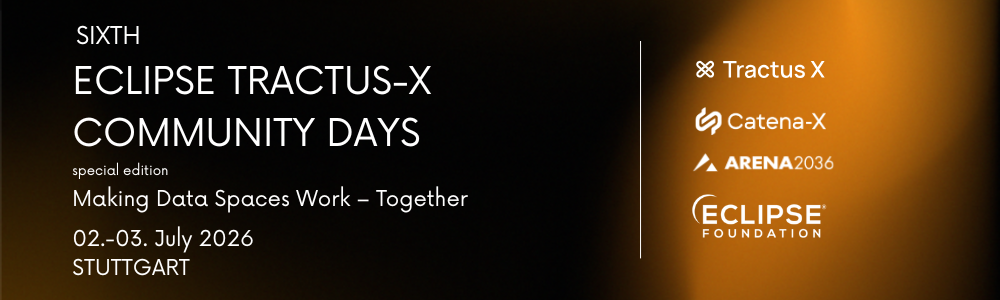
Fifth Eclipse Tractus-X Community Days

· 3 min read
Stephan Bauer
Eclipse Tractus-X Project Lead

eclipse tractus x logo

Dear Eclipse Tractus-X- and Dataspace-Community,

The Eclipse Tractus-X Community Days serve as a platform for collaboration, innovation, and knowledge exchange within the Tractus-X ecosystem. Building on the success of previous events, this fifth edition brings together industry leaders, developers, and open source enthusiasts to help shape the future of digital transformation in the automotive industry.

If you'd like to be involved — whether through a presentation, workshop, or sharing a use case — we'd be glad to hear from you and welcome your contribution to this vibrant community gathering.

New Tractus-X Identity Hub Tutorial Video

· 2 min read
Mathias Brunkow Moser
Eclipse Tractus-X Project Lead
Carlos Diez Rodriguez
Dataspace Architect, Eclipse Committer

identityhub logo

New Tutorial Available

Based on the upstream Identity Hub, one of our brave proud committers Carlos Diez Rodriguez, has created an effective tutorial which will guide you from 0 to hero on how to start developing with the Eclipse Tractus-X Identity Hub!

You will find the tutorial here:

https://eclipse-tractusx.github.io/docs/tutorials/identity-hub

What are our objectives?

We are restarting the development of the Identity Hub (Wallet) in Eclipse Tractus-X.

Our objectives are the following:

  • Create a well documented identity hub using the Eclipse Dataspace Components framework.
  • Implement a multi "-X" dataspace support wallet.
  • Reduce complexity for applications that are willing to use the wallet.
  • Make a reality in Eclipse Tractus-X aspect model credentials issuance, based on frameworks like the dpp-verification and the future Data Trust & Security KIT!
  • Demonstrate the issuance, holding, request and management of membership credentials.

Our next features

Feel free to look at our latest features sig-release identity hub

We are planning to develop a frontend, a backend, have an extensive documentation, and much more!

How can I contribute?

We are looking for developers and brave contributors which want to innovate and collaborate for building this new open source wallet together!

If you are interested on joining the development, feel free to join our open meetings and build dataspaces with us!

Our Matrix Chat

Our Repository

Our Planning Board

Release Planning for Release 25.12

· 7 min read
Stephan Bauer
Eclipse Tractus-X Project Lead
Theresa Hilger
Data Space Operations Manager

eclipse tractus x logo

Hello, Eclipse Tractus-X Community!

Collaboration drives the success of Eclipse Tractus-X, and we are excited to invite you to the Release Planning sessions for R25.12! These sessions are your chance to shape the roadmap, align with the community, and ensure a well-structured release.

Key Information:

  • 📅 Dates and Times: Listed for each session below.
  • 📂 Resources: Visit our open meetings page for all session links and additional documentation.
  • 🔗 Preparation Materials: Ensure readiness by reviewing the provided templates, guidelines, and your own features.

We look forward to seeing you there and working together to make R25.12 a success!

Eclipse Tractus-X Webpage Updated to Docusaurus 3.7.0

· 2 min read
Stephan Bauer
Eclipse Tractus-X Project Lead

Hello Eclipse Tractus-X Community,

We’re happy to announce that the Eclipse Tractus-X website has been successfully updated. The underlying documentation framework, Docusaurus, is now running on version 3.7.0.

This upgrade was essential, as we were previously using an outdated version that limited our flexibility and security.

What's New?

Visually, not much has changed — but you might notice that the News Blog is now grouped by year for improved clarity. While the visible updates are minimal, this upgrade clears the path for more improvements in the future.

Release Planning for Release 25.09

· 9 min read
Theresa Hilger
Data Space Operations Manager
Stephan Bauer
Eclipse Tractus-X Project Lead

eclipse tractus x logo

Hello, Eclipse Tractus-X Community!

Collaboration drives the success of Eclipse Tractus-X, and we are excited to invite you to the Release Planning sessions for R25.09! These sessions are your chance to shape the roadmap, align with the community, and ensure a well-structured release.

New room in our matrix chat -> Release Management New room in our matrix chat -> Test Management

Key Information:

  • 📅 Dates and Times: Listed for each session below.
  • 📂 Resources: Visit our open meetings page for all session links and additional documentation.
  • 🔗 Preparation Materials: Ensure readiness by reviewing the provided templates, guidelines and your own features.

We look forward to seeing you there and working together to make R25.09 a success!

Introducing the New Light Theme for Tractus-X

· One min read
Michaela Kleynhans
Light Theme Webpage for Tractus-X

theme image

Introducing the New Light Theme for Tractus-X: A Fresh, Elegant Look for the page.

Today, we are thrilled to unveil the all-new light theme for Tractus-X, offering a sleek, modern design that enhances both aesthetics and user experience. With its bright open layout and enhanced readability, this update offers a welcoming and user-friendly interface for all users. The new light theme is designed with clarity in mind, ensuring that you can navigate through the world of Tractus-X effortlessly—whether you're on a desktop, tablet, or mobile.

Join us in May 2025 for the Fourth Eclipse Tractus-X Community Days!

· 2 min read
Stephan Bauer
Eclipse Tractus-X Project Lead

eclipse tractus x logo

Dear Eclipse Tractus-X- and Dataspace-Community,

Following the overwhelming positivity of the third Eclipse Tractus-X Community Days, we are pleased to announce the fourth edition, scheduled for May 22-23, 2025, at ARENA2036 in Stuttgart, Germany. Because of the high demand we have expanded our capacity, this year's event will welcome even more participants and feature an expanded range of workshops, challenges and opportunities to collaborate on shaping the future of open-source development in manufacturing and beyond.