Architecture Overview
Contents
| Page | Description |
|---|---|
| Architecture Overview | System architecture, PUSH/PULL mechanism diagrams, and usage guide for the CCM API. |
| CCM API Guide | Notification schemas, endpoint specifications, header models, and JSON payload examples for all CCMAPI endpoints. |
| Requirements | Functional and non-functional requirements, quality attributes, and integration considerations. |
Business Architecture and APIs
Architecture
The Architecture Overview diagram explains the assumptions made in the use case descriptions. It is important to note, that the value of a CCM-Tool increases significantly if it can be integrated via APIs with existing tools (e.g. Supplier Relationship Management,…)
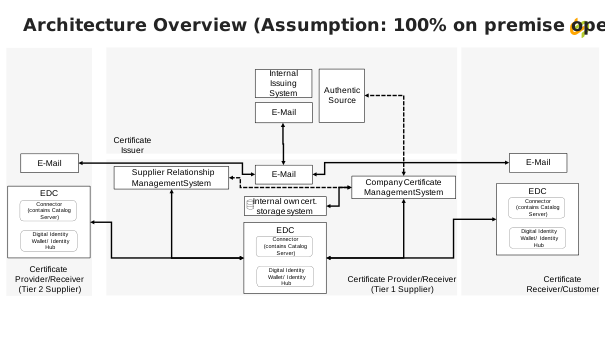
Architecture Overview (Assumption: 100% on premise operation)
The CCM system is a modular, scalable architecture supporting integration with ERP, CRM, and document management systems. It includes a dashboard for monitoring certificate status and pending actions.
Key architectural qualities:
- Integration: Standard APIs or connectors for integration with external systems. Support for importing/exporting data in standard formats (CSV, XML).
- Security: Data encryption at rest and in transit. Strict access controls to sensitive certificate data. Compliance with data protection regulations (e.g., GDPR).
- Scalability: Ability to handle a large number of business partners and certificates. Support for future integration with additional systems or modules.
- Reliability & Availability: High system uptime, backup, and disaster recovery mechanisms.
- Performance: Fast response times for certificate lookups and workflow actions. Efficient batch processing for notifications and reporting.
- Usability: Intuitive user interface for business and technical users. Multilingual support as required.
- Auditability: Comprehensive logging of all user actions and system events. Tamper-proof audit trails for compliance verification.
- Maintainability: Modular architecture for easy updates and enhancements. Clear documentation for system configuration and operation.
API Endpoints and Resources
- Company Certificate Request
- Company Certificate Push
- Company Certificate Status (Accepted / Received / Rejected)
- Company Certificate Available
- Error Handling
Company Certificate Management API (CCMAPI) – Usage Guide
This section explains how to use the Company Certificate Management API (CCMAPI) defined in CX-0135, based on the OpenAPI specification.
The CCMAPI supports two main interaction patterns between Certificate Provider and Certificate Consumer:
- PUSH mechanism – Provider actively sends certificates.
- PULL mechanism – Consumer actively requests or retrieves certificates.
Additionally, CCMAPI defines notification messages to coordinate these interactions.
PUSH Mechanism
In the PUSH mechanism, the Certificate Provider initiates the transfer of a certificate to the Certificate Consumer via the endpoint /companycertificate/push.
High-Level Flow
-
Certificate Consumer exposes a CCMAPI notification API asset (type
cx-taxo:CCMAPI) in its EDC catalog. -
Certificate Provider negotiates a contract for this CCMAPI asset in the Consumer's EDC and obtains an EDR.
-
Using the EDR, the Certificate Provider calls
/companycertificate/pushwith aCertificatePushmessage:- The header identifies sender, receiver, context, message and feedback URL.
- The content contains the
BusinessPartnerCertificatepayload (as defined by the semantic modelurn:samm:io.catenax.business_partner_certificate:3.1.0).
-
Consumer processes the certificate and may send feedback via
/companycertificate/status.
PUSH Sequence Diagram
Key Points
- PUSH is Provider-driven: Provider decides when and for which locations a certificate is sent.
- The field
senderFeedbackUrlin the header tells the Consumer which EDC DSP endpoint to use for feedback notifications. - The certificate content includes
documentID(as defined in the aspect model) and all relevant certificate details and enclosed sites/addresses.
PULL Mechanism
In the PULL mechanism, the Certificate Consumer initiates the retrieval of certificates from the Certificate Provider.
There are two complementary parts:
- Request notification via CCMAPI – Consumer asks Provider for a certificate for a specific legal entity and (optionally) locations.
- EDC catalog lookup and data pull – Consumer looks up the certificate asset in the Provider's EDC catalog and retrieves the actual certificate data.
High-Level Flow
-
Provider creates certificate assets in its EDC catalog:
- Subject
cx-taxo:CompanyCertificateand typecx-taxo:Submodel. - Semantic ID
urn:samm:io.catenax.business_partner_certificate:3.1.0. - Properties such as
certificateTypeandenclosedSitesset according to the model.
- Subject
-
Consumer optionally sends a request via
/companycertificate/requestto indicate which certificate is desired. -
Provider processes the request and returns either:
IN_PROGRESS– processing continues asynchronously.COMPLETED– including thedocumentId(EDC asset ID of the certificate).REJECTED– including one or more errors.
-
For long-running processing, the Consumer polls the same
/companycertificate/requestendpoint again (with a new message but the same business parameters) until aCOMPLETEDorREJECTEDresponse is returned. The Provider never initiates a callback for request state changes. -
After
COMPLETED, Consumer uses thedocumentIdto search the Provider's EDC catalog and retrieves the certificate via the EDC data plane. -
Consumer may send feedback about reception, acceptance or rejection via
/companycertificate/status.
PULL Sequence Diagram
Key Points
- PULL is Consumer-driven: Consumer asks for the certificate when needed.
- The
documentIdin the CCMAPI messages refers to the EDC asset ID of the certificate (except inside the pushed certificate payload, wheredocumentIDrefers to the certificate document itself). - Certificate assets are identified in EDC by the combination of subject, certificate type and enclosed sites.
For the full endpoint reference, notification schemas, and JSON payload examples, see the CCM API Guide.
NOTICE
This work is licensed under the CC-BY-4.0.
- SPDX-License-Identifier: CC-BY-4.0
- SPDX-FileCopyrightText: 2026 BASF SE
- SPDX-FileCopyrightText: 2026 Bayerische Motoren Werke Aktiengesellschaft (BMW AG)
- SPDX-FileCopyrightText: 2026 Cofinity-X GmbH
- SPDX-FileCopyrightText: 2026 Data Space Solutions GmbH
- SPDX-FileCopyrightText: 2026 DCCS GmbH
- SPDX-FileCopyrightText: 2026 Mercedes Benz AG
- SPDX-FileCopyrightText: 2026 Robert Bosch Manufacturing Solutions GmbH
- SPDX-FileCopyrightText: 2026 SAP SE
- SPDX-FileCopyrightText: 2026 sovity GmbH
- SPDX-FileCopyrightText: 2026 T-Systems International GmbH
- SPDX-FileCopyrightText: 2026 Volkswagen AG
- SPDX-FileCopyrightText: 2026 ZF Friedrichshafen AG
- SPDX-FileCopyrightText: 2026 Contributors to the Eclipse Foundation
- Source URL: https://github.com/eclipse-tractusx/eclipse-tractusx.github.io